


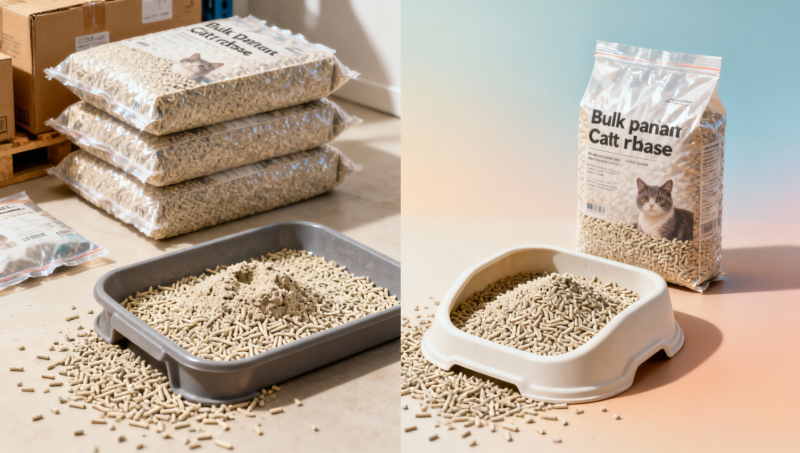
For importers, distributors, and brands, Natural bentonite cat litter bulk purchase starts to pay off when order volume, freight efficiency, and stable quality align. Backed by Natural mineral cat litter ODM and Bentonite clay cat litter OEM service, buyers can reduce unit cost, strengthen brand positioning, and secure reliable supply. This article explains the cost thresholds, sourcing factors, and decision points that make bulk purchasing a smart long-term strategy.
When does bulk buying natural bentonite cat litter become financially worthwhile?
A natural bentonite cat litter bulk purchase usually begins to make commercial sense when the buyer is no longer optimizing for a single shipment, but for a rolling supply plan over 2–6 months. For small retailers or trial importers, buying in limited quantities may reduce risk. For distributors, private label brands, and chain pet supply buyers, the economics change once container utilization, packaging consistency, and repeat demand become predictable.
The key threshold is not only tonnage. It is the combination of three factors: lower unit ex-factory cost, better freight allocation per bag, and fewer quality fluctuations from lot to lot. If one of these three is missing, a bulk deal may look attractive on paper but fail in practical operations. This is why procurement teams, finance approvers, and technical evaluators often review bulk purchase decisions together.
In the pet supplies industry, bentonite litter is often evaluated by clumping speed, dust control, moisture absorption, particle size distribution, and odor management. Buyers who import every month or every quarter can often gain more value from stable raw mineral sourcing than from chasing the lowest spot price. For this reason, natural bentonite cat litter bulk purchase is especially relevant to wholesalers, supermarket suppliers, e-commerce brands, and OEM customers.
The usual cost trigger points buyers watch
In practice, purchasing value often improves when the order moves from sample level to pallet level, then from pallet level to container level. At that point, packaging material planning, production scheduling, and loading efficiency become more controllable. Buyers also gain more leverage in discussing OEM or ODM details such as bag size, fragrance options, private label artwork, and moisture or granule specifications.
- Small trial quantity: useful for quality confirmation, market testing, and internal product comparison, but usually carries a higher unit logistics cost.
- Medium recurring quantity: often suitable for regional distributors or new brands validating monthly turnover and packaging preferences.
- Full container or repeated container orders: typically where natural bentonite cat litter bulk purchase delivers stronger cost efficiency and supply stability.
For many international buyers, the real payoff begins when orders are large enough to support regular production planning and shipping coordination within a 7–15 day production window or a 2–4 week dispatch cycle, depending on packaging complexity and order queue. This matters even more when the product will be sold under a private label and must maintain a consistent consumer experience.
Which cost elements decide whether a bulk purchase truly saves money?
A common mistake in bentonite cat litter sourcing is to compare only the per-ton quotation. In reality, total landed cost includes raw material consistency, packing format, container fill efficiency, freight timing, loading losses, complaint risk, and after-sales handling. A lower initial price can become more expensive if the litter creates high dust, weak clumps, or damaged packaging during transport and warehousing.
To make a rational decision, procurement and finance teams should assess at least 5 cost dimensions: ex-factory product price, packaging cost, freight and port-related cost, quality control cost, and market risk cost. Market risk includes slow turnover, consumer dissatisfaction, and relabeling or replacement expenses if the product fails to meet the target market’s expected performance.
The table below shows how buyers typically compare sourcing models for natural mineral cat litter. The values are not fixed market prices, but practical evaluation dimensions used in B2B purchasing decisions.
Leave A Message
CONTACT US