


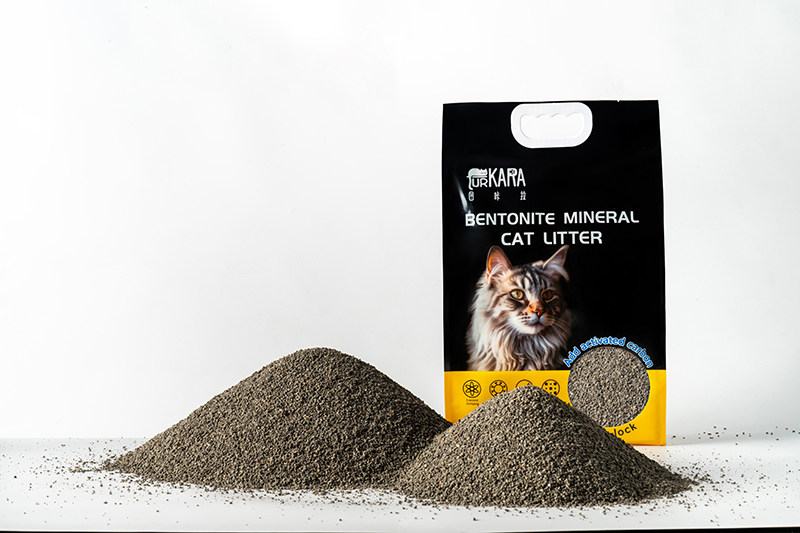
A bentonite cat litter factory should be judged by whether it can produce the same usable product from one batch to the next, not by whether a single retained sample looks acceptable. Consistency means that litter arriving at the customer performs predictably: granules pour cleanly, dust remains controlled, urine forms a removable clump, odors are managed within the intended use conditions, and each bag contains the stated quantity.
For a buyer assessing a supplier, the practical question is: does the factory control variation at its source, or does it only sort out obvious defects at the end of the line? The answer is found in its raw-material management, process controls, batch testing, traceability, and response to non-conforming output.
Start with a defined product standard, not general claims
Terms such as “low dust,” “strong clumping,” or “premium bentonite” are useful product descriptions, but they are not inspection standards. Before comparing factories, define what the finished litter must do in the target market and convert that requirement into measurable acceptance points.
A clumping litter sold for multi-cat households may need a different balance of granule size, absorption speed, and clump integrity than a lightweight retail product designed for easy carrying. Fragranced and unfragranced lines also require separate controls, because fragrance addition can affect perceived odor, coating uniformity, and dust behavior. An OEM specification should therefore distinguish between product families rather than applying one broad standard to every SKU.
These criteria should be agreed before sampling begins. A factory cannot demonstrate repeatability if the buyer changes the definition of an acceptable product from one production run to another.
Raw bentonite control is the foundation of stable output
Bentonite is a natural mineral, so its behavior can vary by mining area, geological layer, weather exposure, and storage conditions. A supplier may have modern screening and packaging equipment, yet still struggle to maintain output if incoming mineral is blended inconsistently or stored without separation.
Ask how raw bentonite is identified from mine to processing line. A robust system normally separates material by source and lot, records inbound checks, and releases raw material only after it meets the internal processing requirement. The most useful evidence is not a statement that the mine is “high quality,” but a clear lot-identification system and records showing how variation is detected before the material reaches the finished product.
For factories with their own mining resources, supply continuity and material traceability can be easier to manage, provided that extraction areas are still controlled and documented. Weifang Hualong Bentonite Co., Ltd., for example, operates in a bentonite-rich area of Weifang and states that it has an exclusive mine. For an OEM or private-label buyer, the relevant assessment point is how that mine-to-factory link is translated into lot segregation, blending rules, and finished-batch traceability.
Raw-material testing should focus on characteristics that influence the selected product design. This can include appearance, particle profile, moisture behavior, swelling or absorption response, and foreign-material screening. The exact test method may differ by factory and destination market, but the method must be applied consistently. Comparing results from different methods or different sample preparation procedures does not reveal meaningful batch variation.
Follow the process points where variation is created
Finished-product testing alone is too late to prevent a recurring issue. The most reliable bentonite cat litter factory monitors the stages where variation is introduced: crushing or granulation, drying, screening, dust removal, additive application, weighing, and sealing.
Granulation and screening
Particle size is more than an appearance issue. It changes how litter flows through filling equipment, how quickly liquid penetrates the bed, how much material adheres to a wet clump, and how much dust is released when a consumer pours the bag. A factory should use defined screen sizes for each product grade and verify the fraction retained or passed at planned intervals.
One common mistake is checking particle size only before packaging. Granules can break during transfers, conveying, or bag filling. Review samples taken after the dust-collection and packing stages, because these are closer to the condition the user receives.
Drying and moisture balance
Drying is often treated as a simple operating setting, but it is a major consistency variable. Feed material with different starting moisture may require different drying conditions. If the operation uses one fixed setting despite changing feed conditions, one batch may be too dry and dusty while another may retain excess moisture.
Assess whether moisture is checked both during processing and on finished lots. Also ask where samples are taken. A sample from one point in a large production run may not represent the whole lot, particularly when storage or cooling conditions vary across the line.
Dust removal and additive application
Dust-control equipment should be assessed under normal production load, not only during a clean demonstration run. Inspect collection points around screening, transfer, and filling. Dust capture protects packaging accuracy and housekeeping as well as consumer-facing product quality.
Where fragrance, deodorizing agents, or other additives are used, uniform distribution matters. Uneven application can produce bags with noticeably different odor intensity or performance. The factory should have a defined addition sequence, equipment-cleaning procedure between formulas, and controls to prevent accidental carryover from a previous product.
Use representative samples and repeatable performance tests
A strong sample from one bag does not prove a stable process. Collect samples across the beginning, middle, and end of a production batch, and where practical, from more than one pallet. Keep sample handling consistent: moisture exposure, storage time, and test conditions can all change litter behavior.
Clumping tests should imitate use without becoming overly theatrical. Apply a controlled liquid volume to a defined litter depth, allow a consistent dwell period, then assess clump formation, lift strength, breakage during scooping, and residue left in the surrounding litter. The purpose is not to create a universal score; it is to compare each lot against the approved product benchmark using the same procedure.
Dust should also be evaluated after realistic handling. A factory sample drawn gently from a container may appear clean, while a retail bag shaken through transport releases a noticeable layer of fines. A simple controlled pour or agitation check can reveal whether the product remains within its intended dust standard after packaging and handling.
Review the factory’s control system, not only its test report
Test reports are useful only when they are linked to identifiable batches, calibrated methods, and clear release decisions. During supplier assessment, ask to see how a finished batch is assigned a code, how test records are retained, and how the factory can trace a complaint back to raw material, shift, production date, and packaging materials.
The response to a failed result is equally important. A dependable system distinguishes between reworkable material, material requiring re-screening, and material that should not be released. It should also investigate the cause rather than merely blending an off-spec batch into later production. Repeated blending can hide variation temporarily while increasing the risk that several customer orders become inconsistent.
Packaging deserves the same discipline. Check scale verification practices, routine net-weight checks, bag seal inspection, print accuracy, and pallet protection. Cat litter is heavy and abrasive; a bag that looks acceptable at the end of the line may fail after stacking, handling, or humid storage if film strength and sealing conditions are not controlled.
Choose a supplier based on evidence across multiple batches
The most useful supplier qualification is a staged review rather than a decision based on one pre-shipment sample. Start with a written specification, evaluate trial material from separate production lots, review the factory’s records and process controls, then confirm that commercial production can meet the same standard.
- Request retained samples or batch records from more than one production period, not only the most recent lot.
- Compare particle profile, dust behavior, clump integrity, odor treatment, and bag weight against the approved reference.
- Confirm that each private-label formula has its own specification and that formula changes require approval.
- Check whether the factory can identify and isolate affected inventory when a quality issue is reported.
- Include packaging, palletization, and transport-facing checks in the approval process.
For export programs, logistics should be considered alongside production consistency. A factory located near major port routes may offer operational advantages, but proximity does not replace quality control. The more important question is whether the supplier protects product condition through storage, loading, and document control so that the approved factory output is the product received by the distributor.
Do not confuse a visually uniform product with a consistent one
Uniform color and neat granules can be reassuring, yet they do not confirm stable moisture, absorption, clumping strength, or low-dust performance. Conversely, a natural mineral product may show minor visual variation while still meeting its functional specification. The decision should rest on agreed performance checks and traceable process evidence, not appearance alone.
A capable supplier makes consistency visible through its operating discipline: controlled raw material, monitored process points, representative sampling, clear release criteria, and a documented response when output drifts. That is the basis for selecting a factory that can support reliable cat litter quality beyond the first order.
Leave A Message
CONTACT US