


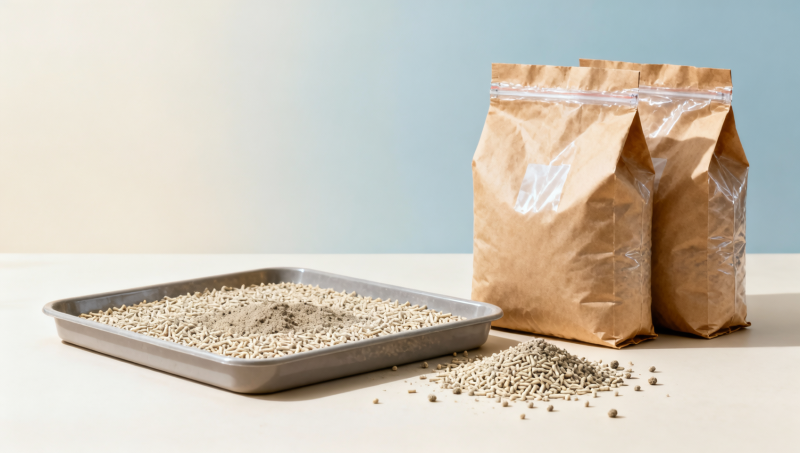
Natural bentonite cat litter bulk purchase often looks straightforward, but hidden cost gaps in freight, dust control, absorbency, and private-label execution can quickly erode margins. For buyers comparing Natural mineral cat litter ODM options or evaluating Bentonite clay cat litter OEM service, understanding mine source, quality consistency, and total landed cost is essential before committing to large-volume orders.
Why bulk buyers often misjudge the real cost of natural bentonite cat litter
In the pet supplies business, the quoted unit price for natural bentonite cat litter is only the starting point. Importers, distributors, private-label brands, and retail buyers usually compare offers by tonnage or container value, yet the true gap appears after freight, breakage, dust complaints, and refill frequency are counted. A lower FOB price can become a higher landed cost within 30–60 days of market use.
This is especially true for clumping litter based on bentonite clay. If granule distribution is unstable, users pour more product per tray, stores face faster stock turnover, and consumers complain about mud-like clumps or dusty rooms. In bulk purchase decisions, 3 core indicators matter together: mine source stability, production consistency, and packaging execution. If one of these fails, cost control becomes difficult.
For technical evaluators and quality managers, hidden cost gaps also include moisture variation, powder proportion, and clump strength after transport. For finance approvers, the concern is different: whether one container really delivers the expected sellable output. For project managers and purchasing teams, lead time predictability matters just as much as unit price, especially when replenishment cycles are planned in 2–4 week windows.
Weifang Hualong Bentonite Co., Ltd. addresses these concerns from the upstream side. Founded in 1972 and developed from its predecessor Bentonite Mine, the company operates in a bentonite-rich area of Weifang, Shandong, with its own mine and complete national mineral approval qualifications. With more than 80,000 square meters of area and access within the one-hour economic circle of Qingdao Port and Weifang Port, it is structurally positioned to support stable bentonite mineral cat litter supply for OEM and ODM buyers.
Where hidden cost gaps usually appear
Bulk buyers often find that the difference between two natural mineral cat litter offers is not in the catalog sheet, but in how the product behaves during shipping, filling, warehousing, and household use. A quotation that looks competitive may carry secondary losses in complaints, repacking, or extra deodorizing support.
- Freight inefficiency: when bulk density or bag configuration is not optimized, each 20-foot or 40-foot shipment carries less commercial value than expected.
- Dust management cost: high powder content increases cleaning, customer dissatisfaction, and possible returns in retail channels.
- Absorbency mismatch: litter that looks acceptable in dry samples may underperform after real use, causing faster consumption and weaker repeat purchase.
- OEM execution loss: label errors, bag seal issues, and packaging delays can postpone launch plans by 7–15 days or more.
Which cost factors matter most when comparing bentonite clay cat litter OEM service
When buyers compare Bentonite clay cat litter OEM service, they should move beyond headline pricing and build a total-cost view. In practice, at least 5 checkpoints influence procurement economics: raw material source, granule sizing, dust level, packaging strength, and shipment coordination. These factors determine whether the product reaches the market with stable quality and acceptable consumer feedback.
Mine ownership or long-term mine control matters because it reduces raw material volatility. For a commodity-like product such as natural bentonite cat litter, upstream instability can affect not only price but also swelling behavior and clump integrity. This is why many experienced buyers ask the same question first: is the supplier only blending and packing, or does it truly control mineral resources?
Packaging is another cost driver that is frequently underestimated. A weak outer bag may look fine at the factory but fail under repeated loading, pallet handling, and sea transport. If 1–3% of goods suffer bag breakage, the resulting warehouse cleanup, claim handling, and resale discount can erase the original price advantage. Private-label programs also face approval costs when artwork revision rounds exceed the original schedule.
The table below helps procurement teams compare visible and hidden costs in a more practical way before placing trial orders or annual supply contracts.
For many B2B buyers, the useful conclusion is simple: a reliable natural bentonite cat litter supplier should help reduce operational friction, not merely provide a nominally cheaper invoice. If the supplier can align product performance, OEM response speed, and shipment coordination, the total procurement equation becomes easier to approve internally.
A practical 4-step review before approving a supplier
- Check mine and factory relationship. This affects raw material continuity and batch repeatability.
- Request a real-use evaluation, not only a dry sample inspection. Test clumping, odor control, and dust within 3–7 days of simulated use.
- Review OEM workflow. Confirm artwork approval, bag format, carton marking, and production schedule.
- Estimate landed cost by shipment cycle. Compare the product on a per-container and per-user-cycle basis, not only per ton.
How to evaluate product performance without overpaying for the wrong specification
Not every market needs the same natural mineral cat litter configuration. A supermarket private label may prioritize price balance and stable clumping. A specialty pet chain may focus more on low dust and consumer comfort. A distributor serving several countries may need multiple bag sizes and multilingual compliance text. Choosing the wrong specification often creates hidden costs faster than choosing a slightly higher-priced but better-matched option.
Technical evaluation should focus on use-related performance instead of generic claims. In most procurement reviews, 4 dimensions are enough to separate practical offers from risky ones: clump speed, clump firmness, dust perception, and odor retention over routine replacement cycles. Operators and after-sales teams should also look at pouring feel and scooping stability, because these directly affect user acceptance.
For bulk orders, sample testing should ideally cover at least 2–3 different use contexts, such as household tray use, retail shelf handling, and warehouse pallet movement. This prevents a common mistake: approving a litter that performs well in the lab but creates excessive dust after long-distance transport. Even a small difference in powder proportion can become visible after container unloading.
The following table can be used as a selection guide when discussing Natural mineral cat litter ODM or OEM projects with a manufacturer.
This kind of matrix is helpful for procurement teams, quality staff, and finance reviewers because it turns a vague performance discussion into a more structured decision. It also makes supplier communication clearer when comparing standard bulk orders with customized OEM or ODM programs.
Why upstream resource control changes performance confidence
A manufacturer with an exclusive mine can usually give buyers a stronger foundation for long-term planning. In bentonite cat litter, raw mineral character influences absorption and clumping more than many new buyers expect. If a supplier depends heavily on external spot sourcing, product fluctuation may become more likely during price swings or peak-season demand.
Weifang Hualong Bentonite Co., Ltd. combines mine resource access, factory manufacturing, and export-oriented sales support through Weifang Tianwu Import and Export Trading Co., Ltd. This structure is relevant for distributors, agents, and private-label buyers who need both mineral supply continuity and responsive international business communication.
What procurement teams should ask about ODM, OEM, and delivery planning
Natural bentonite cat litter projects often fail not because the product is unusable, but because the implementation details were never clarified. Buyers should ask early whether the order is based on standard export packaging, customized OEM bags, or a broader Natural mineral cat litter ODM solution that includes product positioning, packaging suggestions, and market-fit support. These are different service scopes and should not be priced or evaluated the same way.
From a project management perspective, 4 timeline stages are usually worth confirming before deposit payment: sample confirmation, packaging file approval, production scheduling, and shipping arrangement. In many practical cases, standard products move faster, while custom packaging adds 7–15 days depending on artwork readiness and material preparation. Delay often comes from repeated design revision rather than factory production itself.
Port proximity also influences delivery confidence. A supplier located within the one-hour economic circle of Qingdao Port and Weifang Port has a practical logistical advantage for export planning, especially when shipment windows are tight or buyers need flexible routing options. This matters for importers dealing with seasonal promotions, distributor replenishment, or e-commerce warehouse calendars.
The service flow below shows what a disciplined bulk purchase process should look like when working with a bentonite mineral cat litter manufacturer.
A clear process reduces avoidable friction for all stakeholders: purchasing teams gain predictability, technical reviewers gain measurable checkpoints, finance teams reduce approval risk, and distributors gain better launch timing. In bulk pet supplies trade, this discipline often matters more than chasing the lowest opening offer.
Key questions for compliance and quality communication
- What product documents are available for market entry, internal review, or import filing where applicable?
- Can the supplier explain raw material origin and basic quality control points in a clear, repeatable way?
- How are batch differences handled if the buyer requires repeat orders over several months or quarters?
- What packaging checks are performed before shipment to reduce leakage, print error, or label mismatch?
Common mistakes, realistic expectations, and FAQ for bulk natural mineral cat litter
The most common purchasing mistake is assuming all bentonite cat litter is interchangeable. In reality, different mineral sources, granule controls, and packaging execution levels can lead to noticeably different user feedback. Another mistake is over-customizing too early. For first cooperation, many buyers benefit from starting with a manageable specification and then refining the OEM program after one or two purchase cycles.
A realistic expectation is also important. Natural bentonite cat litter can offer strong clumping and practical odor control, but performance should be judged according to target market needs, not extreme marketing language. Procurement should balance 3 variables together: performance, logistics efficiency, and brand presentation. If one variable dominates too much, total commercial performance may suffer.
For distributors and agents, repeatability may be more important than chasing novelty. For end consumers and retail brands, dust perception and ease of scooping strongly influence repurchase. For finance teams, the key question is whether the supplier can support stable business over multiple ordering windows, such as monthly, quarterly, or seasonal replenishment.
The FAQ below addresses questions that usually come up during early supplier evaluation and bulk order planning.
How should buyers compare natural bentonite cat litter offers fairly?
Compare them on at least 5 points: mine source, clumping behavior, dust after handling, packaging strength, and shipment readiness. Ask for sample testing under real use conditions for 3–7 days, then estimate cost per usable cycle rather than only cost per ton. This gives a more reliable picture for B2B purchasing.
What is usually more important, lower price or stronger clumping?
That depends on the sales channel. Discount retail may focus on budget control, while premium or repeat-purchase channels often benefit from better clumping and lower dust because complaint rates and negative reviews matter more. In many cases, a moderately higher-performing litter lowers total user consumption and protects brand value.
How long does an OEM or ODM cat litter project usually take?
The schedule depends on whether packaging is standard or customized. A practical review should consider 4 stages: sample confirmation, packaging approval, production, and shipment. Custom artwork or bag material preparation can add 7–15 days beyond standard handling, so early file confirmation is important when launch dates are fixed.
What should quality teams inspect before approving a large order?
Focus on batch consistency, dust behavior after movement, clump firmness, and packaging durability. If possible, inspect not only the sample itself but also how the bag performs during stacking and unloading. These checks reduce the chance of hidden cost appearing after the goods have already arrived at the destination warehouse.
Why choose us for bulk bentonite mineral cat litter supply
For buyers evaluating natural bentonite cat litter bulk purchase, the real advantage lies in supply chain control and implementation discipline. Weifang Hualong Bentonite Co., Ltd. has roots going back to 1972, developed from a bentonite mine foundation, and operates with an exclusive mine in a resource-rich region of Shandong. This helps support continuity in bentonite mineral cat litter manufacturing rather than relying only on external raw material trading.
The company’s location in Jiulong Industrial Park, Fangzi District, Weifang, within the one-hour economic circle of Qingdao Port and Weifang Port, provides practical export convenience for global shipments. For OEM and ODM buyers, this means communication can extend beyond product supply to packaging coordination, private-label execution, and shipment planning with fewer avoidable transfer points.
If you are comparing Natural mineral cat litter ODM solutions or Bentonite clay cat litter OEM service, you can discuss concrete topics instead of generic sales language. Typical consultation items include product specification matching, bag size planning, sample support, packaging confirmation, delivery cycle arrangement, and quotation comparison based on target market needs. This is useful for importers, distributors, brand owners, and corporate purchasing teams alike.
You can contact us to confirm 6 practical points before moving forward: target market positioning, expected order volume, preferred bag format, performance priorities such as dust and clumping, delivery timeline, and whether standard export packing or private-label OEM/ODM support is required. A structured discussion at the beginning usually saves much more cost than trying to fix preventable mistakes after shipment.
What you can ask us about now
- Parameter confirmation for natural bentonite cat litter suited to your distribution channel or private-label plan.
- Sample support for clumping, dust perception, and packaging review before larger commitment.
- OEM or ODM discussion covering bag design workflow, printing details, and standard vs customized packing.
- Lead time and shipment planning based on your replenishment window, container schedule, and destination market.
- Quotation communication based on total landed cost thinking, not only the opening unit price.
Leave A Message
CONTACT US