


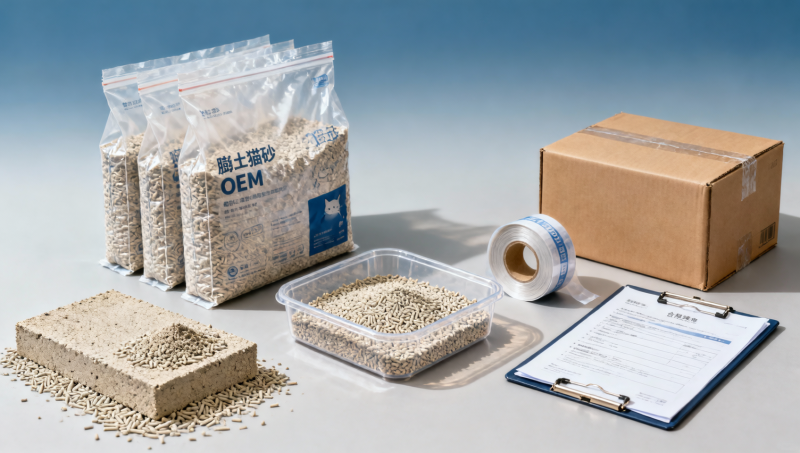
A bentonite clay cat litter OEM launch can be delayed by more than packaging or shipping—it often hinges on mine qualification, formula validation, dust and clumping tests, packaging readiness, compliance documents, and stable raw material supply. For buyers exploring Bentonite clay cat litter OEM service, Natural mineral cat litter ODM, or Natural bentonite cat litter bulk purchase, understanding these risks early helps avoid costly setbacks and keeps private label projects on schedule.
Why do bentonite cat litter OEM projects get delayed in the first place?
In the pet supplies industry, a delayed launch is rarely caused by one issue alone. More often, it is the result of 3–5 linked bottlenecks appearing at the same time: unstable raw material planning, incomplete packaging confirmation, slow sample approval, missing compliance files, or production slot conflicts. For importers, distributors, private label brands, and procurement teams, these delays affect not only delivery dates but also seasonal sales windows and retail listing schedules.
Bentonite clay cat litter OEM projects are especially sensitive because the product must perform consistently in real use. End consumers expect fast clumping, manageable dust levels, acceptable odor control, and a package that survives warehousing and ocean freight. That means a supplier cannot simply produce a visually similar cat litter. The launch depends on whether the formula, granule size, moisture level, packing materials, and loading plan are aligned from the beginning.
For technical evaluators and quality teams, the risk starts even earlier. If a supplier has no clear mineral source, no stable production process, or no practical test routine for bulk density, absorbency, dust tendency, and clump strength, the project can lose 2–4 weeks before formal production even starts. This is why upstream control matters as much as downstream logistics.
Weifang Hualong Bentonite Co., Ltd. has a practical advantage here. Founded in 1972 with its predecessor as a bentonite mine, the company operates in a bentonite-rich area of Shandong and has an exclusive mine covering more than 80,000 square meters. For OEM and ODM buyers, this structure helps reduce one major launch risk: dependence on uncertain third-party raw material sources during critical approval and production phases.
- A sample may pass visual review but fail user testing after 7–10 days of actual litter box use.
- Packaging artwork may be approved, while bag material strength or print lead time still remains unresolved.
- A price may be accepted, but the supplier may not yet have confirmed production sequence, loading quantity, or export files.
The most common delay categories buyers should review early
The earlier these categories are mapped, the easier it is to control launch timing. In many private label projects, the first delay appears during the handoff between commercial discussion and technical execution. Sales may confirm quantity and target price, while the quality or engineering side is still waiting for grain size range, fragrance options, or package drop-resistance data.
This table shows why a bentonite clay cat litter OEM launch should be managed as a cross-functional project rather than a simple purchase order. When procurement, QA, packaging, and logistics are coordinated in parallel instead of in sequence, launch risk is easier to contain.
Which technical and quality issues slow down sample approval?
Sample approval is one of the most underestimated stages in Natural mineral cat litter ODM projects. Many buyers ask for a sample, review only appearance and price, and then move directly to packaging design. Later, the product fails internal use testing because clumps break during scooping, dust rises too quickly when poured, or odor control does not match market expectations. This can send the project back by another 2–3 rounds of sampling.
For bentonite cat litter, several technical variables interact. Granule size influences both pouring feel and dust perception. Moisture level affects storage stability and initial performance. Sodium activation level or blending approach can change clumping speed and hardness. Fragrance addition may improve shelf appeal for some markets while creating acceptance risks in others. A buyer who does not define target performance early often receives a sample that is usable, but not commercially suitable.
This is where a manufacturer with mine access and long production history can support faster decision-making. Weifang Hualong Bentonite Co., Ltd. works from upstream mineral resources to finished bentonite mineral cat litter products. In practice, that helps buyers discuss not only the final bag, but also the source stability behind the formula. For technical assessment personnel, this matters because batch repeatability can be more important than one strong sample.
A useful review window for sample validation is usually 7–15 days, not 1 day. Teams should test at least 3 dimensions: pouring dust, clump integrity after contact with liquid, and odor control over repeated litter box use. For distributor and brand customers, one more dimension matters: how the product compares with the current benchmark item in the target market.
Key performance points to confirm before mass production
Before confirming a Natural bentonite cat litter bulk purchase, buyers should request a practical technical checklist. It does not need to be overly academic, but it should be specific enough to avoid ambiguous approval. The following points are often more useful than general statements like “low dust” or “strong clumping.”
- Granule range: confirm whether the product is fine, mixed, or coarse grade, and whether the target market prefers softer paw feel or stronger clump body.
- Dust behavior: assess visible dust during pouring and refilling, especially after transportation vibration or repeated handling.
- Clump strength: check whether clumps remain intact after 1–3 minutes and whether they break during routine scooping.
- Odor profile: review both fragrance and fragrance-free options, because different retail channels and end users respond differently.
- Storage condition tolerance: consider whether the litter remains stable under common warehouse humidity and shipping cycles.
Why one approved sample is not always enough
In OEM launches with medium or large volume, many buyers now request pre-production confirmation after initial sampling. This step is helpful because a hand sample, a pilot sample, and a production batch are not always identical in texture and handling feel. Even a small shift in moisture or screening can change consumer perception. A 2-step approval model is often safer: first sample approval, then pre-mass-production confirmation based on the actual production plan.
How do packaging, compliance, and logistics create avoidable delays?
Packaging is one of the most visible parts of a cat litter OEM launch, but it is also one of the most likely hidden delay sources. Buyers often focus on visual design and forget material lead time, sealing performance, handle strength, carton arrangement, pallet logic, or container loading efficiency. If a bag looks attractive but tears under 5 kg, 10 kg, or higher retail filling conditions, the launch can stall at the final stage.
Compliance is another common blocker. Bentonite cat litter is not the same as a food item or a chemical product, yet buyers still need accurate labels, basic product descriptions, packing lists, and country-specific import documents where applicable. If the private label package includes claims such as dust control, odor control, or natural mineral positioning, wording should remain clear, reasonable, and aligned with what the product actually delivers. Ambiguous labeling invites rework.
Logistics planning should begin before final packing approval, not after. Weifang Hualong Bentonite Co., Ltd. is located within the one-hour economic circle of Qingdao Port and Weifang Port, which is relevant for export timing. For bulk and container buyers, port access can affect the flexibility of booking and dispatch. But even with a favorable location, delays still happen if container loading plans, bag dimensions, or carton stacking methods are not defined early.
A practical launch schedule usually has 4 stages: sample confirmation, package confirmation, mass production, and shipment release. If any stage starts late, the entire chain shifts. In many cases, packaging film procurement alone can consume 7–12 days depending on artwork revision cycles and supplier readiness.
A practical checklist for launch coordination
For project managers and purchasing teams, the following table helps separate commercial approval from execution readiness. This is especially useful in Bentonite clay cat litter OEM service projects where different departments approve different items.
The value of this checklist is simple: it reduces the gap between “approved for purchase” and “ready to ship.” In many delayed projects, the first status is achieved, but the second is not.
What should buyers compare when selecting a bentonite cat litter OEM supplier?
A purchasing decision should not be based on price alone, especially for private label cat litter. A lower offer may hide unstable raw materials, outsourced processing, limited customization depth, or weak schedule control. For finance approvers, the visible cost per ton or per bag is only one part of the total project cost. Delays, claims, reprints, replacement shipments, and lost shelf time can be more expensive than a small difference in unit price.
Buyers evaluating Natural mineral cat litter ODM suppliers should compare at least 5 areas: resource control, production capability, product consistency, packaging execution, and export coordination. If the supplier controls its own mine or has direct mineral access, it may better support stable supply and repeatability. If the supplier has been engaged in bentonite production for decades, discussions about formulation adaptation are usually more efficient than with a general trader.
Weifang Hualong Bentonite Co., Ltd. combines mining background, manufacturing focus, and export-oriented sales support through Weifang Tianwu Import and Export Trading Co., Ltd. For overseas buyers, this structure can simplify communication across raw material understanding, factory execution, and export handling. It is particularly relevant when a buyer needs OEM and ODM support rather than a standard bulk commodity transaction.
A sound supplier review should also include schedule realism. Ask whether the supplier can support sample dispatch in a defined window, whether packaging development follows a fixed confirmation process, and whether bulk shipment planning can be mapped in advance. A realistic 3-stage timeline is more useful than an aggressive promise without operational backing.
Supplier evaluation matrix for procurement and management teams
The table below helps procurement, project owners, and decision makers review a bentonite cat litter OEM supplier beyond headline pricing.
This comparison is useful for distributors, retailers, and sourcing offices because it turns a broad supplier conversation into a decision framework. It also helps finance teams see where higher reliability may justify a more stable total landed cost.
Cost risk versus unit price
In cat litter sourcing, the cheapest quote may carry the highest correction cost. If a shipment arrives with excessive powder, weak bag seals, or inconsistent clumping, the buyer may face returns, marketplace complaints, or brand damage. A better question is not “Who offers the lowest number today?” but “Which supplier helps us launch on time with repeatable product performance over the next 2–4 orders?”
How can teams reduce delay risk before placing a bulk order?
The best way to prevent a delayed Bentonite clay cat litter OEM launch is to front-load decisions that usually get postponed. Buyers should lock performance targets, packaging specifications, and approval responsibilities before the purchase order is issued. This is especially important in pet supplies, where a product must satisfy both commercial presentation and daily user experience.
A simple 6-point process works well for many OEM and ODM projects. First, define target market and price level. Second, confirm the product style, such as dust expectation, granule mix, and fragrance preference. Third, validate sample performance through use-based testing. Fourth, finalize packaging files and bag materials. Fifth, align production and inspection timing. Sixth, confirm shipment documents and loading plans. Each missed point can create a delay of several days to several weeks.
Quality and safety teams should also be involved earlier. Their review should include package wording, routine inspection focus, and storage or handling concerns. For example, if a market needs stronger resistance to warehouse stacking pressure or longer transit cycles, carton design should reflect that before print approval. This is more efficient than revising after packaging procurement has started.
For project owners and distributors launching a new private label line, it is also wise to plan one contingency step. Keep either an alternative packaging schedule or a backup product specification window. That does not mean lowering standards. It means protecting the launch date if one variable changes unexpectedly.
Recommended pre-order checklist
- Confirm 3 core product targets: clumping behavior, dust expectation, and odor approach.
- Set a sample review period of at least 7–15 days with real usage feedback.
- Approve bag structure, print text, and carton pattern before scheduling mass packing materials.
- Define who signs off technical items, who approves artwork, and who releases shipment.
- Ask for a realistic production and dispatch timeline instead of a single estimated date.
- Review document needs for the destination market before container booking.
FAQ for buyers, importers, and brand owners
How long does a bentonite cat litter OEM launch usually take?
A practical range depends on sample rounds, packaging complexity, and order volume. If the product specification is clear and artwork is ready, the process may move through sampling, package confirmation, production, and shipment in several weeks. If there are 2–3 sample revisions, new bag development, or slow cross-department approvals, the timeline extends quickly. Buyers should manage by milestones rather than by one promised date.
What causes the biggest delay after the sample is approved?
Packaging is often the main cause. Artwork text, barcode placement, film procurement, bag sealing trials, and carton setup can consume more time than expected. The second major cause is incomplete readiness for shipment documents and loading plans. This is why commercial approval should always be followed by operational confirmation.
What should procurement teams ask before confirming a Natural bentonite cat litter bulk purchase?
Ask about raw material stability, sample-to-batch consistency, available pack sizes, private label support, inspection focus, and export follow-up. Also ask what information the supplier needs from your side to avoid delay. In many projects, the supplier is waiting for confirmed artwork, market label text, or final packing structure while the buyer assumes production is already in progress.
Is OEM always better than buying a standard product?
Not always. OEM is better when you need differentiated packaging, market-specific positioning, custom fragrance strategy, or distributor branding. If speed is the only priority and branding is not critical, a standard product may launch faster. The right path depends on whether your priority is margin, speed, channel control, or long-term brand building.
Why work with us when timing, supply stability, and OEM execution matter?
For buyers of bentonite mineral cat litter, launch timing depends on more than a quotation. It depends on upstream resource control, realistic sampling, production coordination, packaging readiness, and export support. Weifang Hualong Bentonite Co., Ltd. offers a combination that is directly relevant to these needs: a long operating history dating back to 1972, an exclusive mine, complete national mineral approval qualifications, and a production base of more than 80,000 square meters in a bentonite-rich region.
For international market development, Weifang Tianwu Import and Export Trading Co., Ltd. focuses on the sale of bentonite mineral cat litter products and supports OEM and ODM communication. This helps overseas customers discuss technical options, packaging requirements, and shipment arrangements in a more organized way. For importers, distributors, private label brands, and sourcing teams, that means fewer gaps between inquiry, sampling, order execution, and export delivery.
If you are evaluating Bentonite clay cat litter OEM service, Natural mineral cat litter ODM, or Natural bentonite cat litter bulk purchase, you can contact us to discuss practical project details, not just general interest. We can communicate around product style, pack sizes, sample planning, OEM or ODM direction, expected lead time, and export coordination points based on your target market and channel plan.
You are welcome to reach out for sample support, parameter confirmation, private label packaging discussion, bulk purchase planning, delivery schedule review, and quotation communication. If your current concern is launch delay, we can start by checking 5 key points together: raw material readiness, product target, package status, timeline expectation, and shipment requirements.
Leave A Message
CONTACT US