


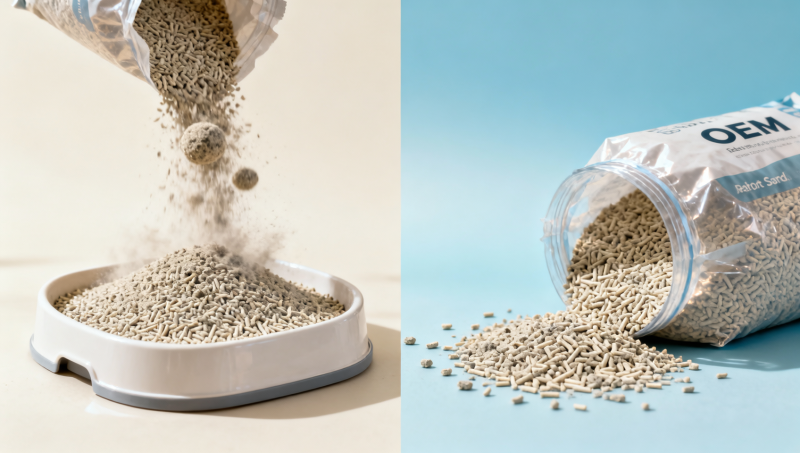
Choosing between low dust and hard clumping in OEM bentonite cat litter can directly impact user satisfaction, product performance, and market success. As a trusted manufacturer offering Bentonite clay cat litter OEM service, Natural mineral cat litter ODM, and Bentonite mineral cat litter wholesale, Weifang Hualong helps global buyers balance dust control, clumping strength, and private label needs with reliable mineral resources and decades of production expertise.
Why does the low dust versus hard clumping decision matter so much?
For distributors, retailers, and private label buyers, bentonite cat litter is not a simple commodity. Two products may look similar in packaging, yet perform very differently after 7 to 30 days of household use. Low dust influences shelf appeal, user comfort, warehouse cleanliness, and complaint rates. Hard clumping affects scooping efficiency, odor control, litter consumption, and repeat purchase behavior. In OEM projects, choosing the wrong balance can hurt both brand reputation and operating margins.
End users often notice dust first because it is visible during pouring, refilling, and daily cleaning. However, operators and technical evaluators usually focus on clump strength because weak clumps break apart, contaminate the remaining litter, and shorten the cleaning cycle. In practical terms, a product that pours cleanly but forms soft clumps may still disappoint households, catteries, and pet product distributors within 2 to 4 weeks.
This is why procurement teams should not ask only one question such as “Which is better?” A more useful question is: which performance profile matches the target market, bag size, price point, and user habits? A premium supermarket line, a high-volume discount line, and a professional pet store label may each need a different balance between dust reduction and clump hardness.
Weifang Hualong Bentonite Co., Ltd. approaches this issue from the source. Founded in 1972, with its predecessor as a Bentonite Mine, the company operates in a bentonite-rich area of Weifang, Shandong, and has an exclusive mine covering more than 80,000 square meters. For OEM and ODM buyers, source stability matters because mineral consistency, processing control, and logistics access within the one-hour economic circle of Qingdao Port and Weifang Port support more predictable quality and delivery planning.
What different buyers usually care about
- Information researchers compare low dust cat litter, hard clumping cat litter, OEM bentonite cat litter, and private label options to understand the market before contacting suppliers.
- Purchasing managers look at 3 core dimensions: quality consistency, landed cost, and delivery reliability.
- Quality control and safety teams examine dust behavior during filling, storage, and transport, plus moisture stability and foreign matter control.
- Distributors and brand owners care about complaint reduction, reorder rate, and whether the product matches local consumer expectations.
When these concerns are aligned early, OEM bentonite cat litter selection becomes more efficient. Instead of debating abstract performance claims, buyers can create a realistic product brief with measurable priorities, target channels, and acceptable trade-offs.
How do low dust and hard clumping compare in real product performance?
In bentonite cat litter, low dust and hard clumping are related but not identical goals. Dust performance is influenced by raw mineral quality, granule grading, drying control, screening, and handling. Clumping strength depends on mineral swelling behavior, particle distribution, moisture interaction, and formula adjustment. Improving one side is possible without maximizing the other, which is why OEM development requires a balanced specification rather than a single claim.
In many markets, consumers describe low dust as cleaner pouring, less airborne powder, and reduced tracking of fine particles around the litter box area. Hard clumping is usually judged within seconds to minutes after contact with liquid. Buyers often use practical checks across 3 stages: pouring, clump formation, and scooping after a set waiting period such as 5 to 15 minutes.
The table below helps compare the commercial implications of both priorities in OEM bentonite cat litter programs. It is especially useful for sourcing teams that need to align product development, package claims, and end-market positioning before sample approval.
The comparison shows that there is no universal winner. In many successful private label projects, the better strategy is to define an acceptable dust range and an acceptable clump strength range, then optimize the product for the intended sales channel. That approach reduces mismatch between packaging promise and real-world use.
Where trade-offs usually appear
Trade-offs often appear when buyers push too aggressively for one headline feature without clarifying market context. For example, a product intended for budget retail may need a practical balance that supports cost control, while a premium private label line may justify tighter particle grading and stronger screening to improve low dust behavior. Technical evaluation should therefore include at least 3 to 5 sample comparisons under the same test routine.
Another common issue is confusing a short sample test with long-term user experience. A litter may appear hard clumping on day 1 but behave differently after transport vibration, repeated bag opening, or storage in humid conditions for several weeks. This is why OEM suppliers and buyers should evaluate not only immediate results but also packaging, storage, and logistics effects.
Which technical factors should OEM buyers assess before approving a formula?
Technical assessment should start with realistic usage conditions, not brochure language. In bentonite cat litter, particle size distribution, absorption response, moisture condition, dust tendency during pouring, and clump integrity after contact with liquid all influence user satisfaction. A complete review usually includes 5 key checks: granule grading, dust release, clump hardness, odor control behavior, and packaging stability during transport.
For OEM projects, buyers also need to define whether the product targets fine granules, mixed granules, or a broader grading suitable for cost-sensitive channels. Smaller granules may improve surface coverage and clumping response but can increase sensitivity to dust control if screening is not handled well. Larger granules may look cleaner but can feel less refined in some premium consumer segments.
The following table can be used as a practical selection checklist during sample review, supplier discussions, and internal approval meetings. It helps cross-functional teams compare technical needs with market expectations and avoid approving a product only because one feature seems impressive at first glance.
This type of checklist is especially useful for project managers, financial approvers, and business evaluators because it converts a subjective discussion into a structured decision process. Instead of debating whether a sample “feels better,” teams can compare whether it meets the required application scenario and claim strategy.
A practical 4-step OEM evaluation process
- Define the target market and channel, such as e-commerce, supermarket, pet specialty retail, or distributor wholesale.
- Set 3 to 5 priority indicators, for example dust control, clumping speed, bag size, fragrance preference, or price range.
- Review samples using the same test method, ideally across repeated use rather than a single pour test.
- Confirm packaging, labeling, lead time, and shipping plans before final OEM approval.
A structured process saves time later. It reduces reformulation requests, repeated sampling, and the risk of launching a private label cat litter that does not match the target customer profile.
How should procurement teams choose the right profile for different market scenarios?
Procurement teams should match product performance with channel economics and user expectations. For example, apartment pet owners and premium retail buyers tend to react strongly to visible dust during pouring. Multi-cat households and high-frequency users often judge value through clump strength and litter consumption over 2 to 6 weeks. A good purchasing decision is therefore scenario-based, not only price-based.
Distributors also need to consider claim language and after-sales support. If the package highlights low dust, customer service teams should be prepared to explain expected handling conditions, storage advice, and litter box maintenance routines. If the main claim is hard clumping, the product should support clean scooping under normal daily use rather than just laboratory-style demonstration.
The matrix below offers a selection guide for common pet products market scenarios. It can help buyers, finance teams, and decision-makers prioritize what matters most before negotiating price, packaging, and shipment schedules.
This kind of scenario-based selection is more reliable than buying only on headline price. A slightly lower-priced product can create higher total cost if it drives more complaints, more returns, or lower repeat ordering. For procurement and finance teams, the best value is often the product that aligns performance, complaint control, and reorder potential.
Common purchasing risks to avoid
- Approving a sample after only one quick test instead of checking repeat use over several days.
- Using the same specification for all channels, even though premium online sales and wholesale distribution often require different positioning.
- Ignoring transport and storage effects, especially for export orders moving through port logistics and longer transit cycles.
- Promising aggressive low dust or hard clumping claims without confirming stable production consistency.
A dependable supplier relationship reduces these risks. Source mine control, stable processing, and export coordination are all important when buyers need repeatable results rather than one-time sample success.
What should buyers know about OEM service, delivery planning, and quality consistency?
For OEM bentonite cat litter, product performance is only one part of the project. Buyers also need clarity on customization scope, sample confirmation, packaging design, production scheduling, and shipment coordination. Typical OEM workflows can involve 4 to 6 steps from initial inquiry to export loading, and delays often happen when specifications are vague or packaging details are finalized too late.
Weifang Hualong combines upstream mineral resource advantages with manufacturing specialization in bentonite mineral cat litter products. Its long operational history, complete national mineral approval qualifications, and exclusive mine provide a stronger base for raw material continuity. For international business expansion, the company established Weifang Tianwu Import and Export Trading Co., Ltd. to focus on overseas sales, which can support smoother communication for global buyers evaluating OEM and ODM cooperation.
Location also matters in export planning. Being within the one-hour economic circle of Qingdao Port and Weifang Port can help buyers manage transit planning, especially when comparing shipping routes, lead time windows, and container loading coordination. In practice, shorter inland transfer complexity may support better shipment scheduling, particularly for recurring orders or urgent replenishment needs.
Quality consistency in cat litter is not only about one batch passing a sample review. It also depends on repeatability across production runs, packaging performance, storage stability, and communication accuracy. Buyers should confirm at least 6 discussion points early: target market, granule profile, dust expectation, clumping expectation, packaging format, and delivery timeline.
Questions worth clarifying before placing an OEM order
Product and formula questions
- Which target market is this formula intended for: premium retail, mass retail, distributor wholesale, or specialty pet channels?
- Is the priority low dust, hard clumping, or a balanced profile?
- What sample evaluation method will both parties use to reduce misunderstanding?
Project and delivery questions
- What is the expected production and shipment window, such as 2 to 4 weeks for confirmation plus production planning depending on order complexity?
- Which packaging details must be locked before mass production begins?
- What documents or commercial information are needed for export and internal approval?
These questions shorten negotiation time and improve internal coordination among purchasing, QC, finance, and sales departments. They also help the supplier provide a more accurate quotation and project recommendation.
FAQ: how do buyers avoid mistakes when choosing OEM bentonite cat litter?
Is low dust always better than hard clumping?
Not always. Low dust is often critical for premium household positioning and user comfort, but hard clumping may have a stronger effect on daily cleaning efficiency and long-term satisfaction. For many OEM projects, the best answer is a balanced formula that meets 2 priorities at once: controlled dust during pouring and stable clumps during scooping.
How many samples should a buyer compare before approval?
A practical approach is to compare at least 3 samples under the same test conditions. If the project covers multiple channels or price tiers, 4 to 5 samples may be more useful. Compare them across pouring, clumping after 5 to 15 minutes, scoop integrity, and repeat handling after storage. This gives a more reliable picture than selecting a formula from a single quick demonstration.
What do distributors and retailers usually ask first?
They usually ask about product positioning, dust behavior, clumping strength, package options, and delivery timing. After that, they want to know whether the supplier can support OEM or ODM needs, repeat orders, and stable export coordination. For private label launches, buyers also ask about claim direction and how to avoid mismatch between package wording and real product behavior.
How can QC teams reduce complaint risk after launch?
QC teams should align incoming sample checks with market claims and run a simple repeatable inspection routine. A 3-part method works well: observe dust during pouring, evaluate clumps after a fixed waiting time, and check product condition after basic storage or transport simulation. Complaint risk usually falls when the approved routine matches actual consumer use rather than internal assumptions alone.
What is the most common mistake in OEM bentonite cat litter purchasing?
The most common mistake is trying to maximize every feature at once without defining the target market. That often leads to confusion, re-sampling, and cost pressure. A clearer method is to rank 3 priorities first, such as low dust, hard clumping, and budget range, then select the formula and packaging that best support those priorities.
Why choose us for OEM bentonite cat litter development and supply?
For buyers comparing low dust versus hard clumping in OEM bentonite cat litter, supplier selection should go beyond price sheets. Weifang Hualong offers a combination of mine-based resource support, long manufacturing history since 1972, specialization in bentonite mineral cat litter products, and practical OEM and ODM service capability. This matters when your team needs not just samples, but a supplier that understands raw material consistency, production control, and export-oriented cooperation.
The company’s location in the bentonite-rich area of Weifang, together with convenient access to Qingdao Port and Weifang Port, supports more efficient logistics planning. For distributors, wholesalers, private label brands, and pet product importers, this can make communication on lead time, replenishment, and shipment scheduling more straightforward. It is especially useful for businesses managing seasonal purchasing cycles or multi-batch rollout plans over 1 to 4 quarters.
If you are evaluating product positioning, you can consult on formula direction, granule preference, dust and clumping priorities, packaging discussion, sample support, and order planning. If you are preparing for procurement approval, you can also discuss delivery timing, OEM or ODM scope, export coordination, and the practical differences between premium and cost-balanced bentonite cat litter lines.
To move your project faster, prepare 5 points before inquiry: target market, desired claim focus, granule preference, packaging idea, and expected order schedule. With those details, the discussion becomes more efficient and more likely to produce a commercially workable solution. You can also review Natural bentonite cat litter as a starting point for product selection, private label planning, or wholesale discussion.
Leave A Message
CONTACT US