


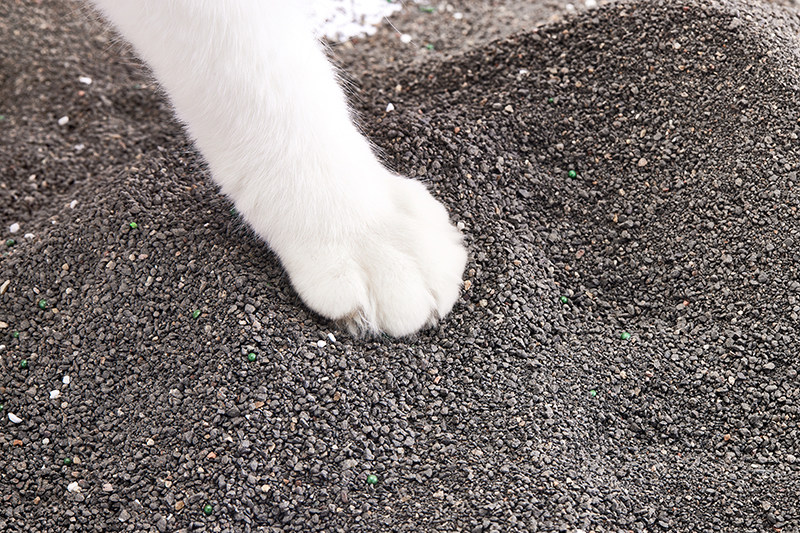
Why does mineral cat litter track so much in daily use?
Mineral cat litter is popular for fast clumping and reliable odor control, yet tracking often becomes the first complaint at home.
The reason is usually not just the litter itself.
Granule size, paw shape, box depth, fill level, and room humidity all work together.
Fine particles cling more easily to fur and paw pads.
A shallow litter layer also makes it easier for cats to kick material out during covering.
In practical use, tracking gets worse when the litter box sits near smooth floors, narrow corners, or heavy foot traffic.
That is why solving tracking starts with observation, not only replacement.
A better question is this: does the litter leave the box because of particle behavior, or because the setup encourages scatter?
High-quality bentonite material can reduce the problem, especially when particle consistency is stable and loose dust is controlled at the source.
This matters because cleaner floors also mean easier daily maintenance and fewer complaints about the litter area.
Is dust always a product issue, or can usage habits make it worse?
Dust is not always a sign of poor mineral cat litter, although poor raw material processing can certainly increase it.
More often, dust appears when litter is poured too quickly, stored in damp spaces, or over-stirred during cleaning.
Old litter that has absorbed moisture can break down faster.
Once granules weaken, each scoop creates more fine powder.
Another overlooked cause is aggressive clump removal.
If a scoop crushes partly formed clumps, the litter bed turns dusty even when the original material was clean.
This is where material quality still matters.
A refined bentonite product with low powder content and stable clump strength performs better over time.
For example, some premium options keep powder content around 0.01% and powder conversion around 0.13%.
That kind of control helps reduce airborne dust during pouring and scooping.
So the better approach is to judge dust from both sides: product quality and operating habits.
A quick way to identify the real cause
If dust rises mainly when opening the bag, the issue may come from processing or transport abrasion.
If dust increases after several days, moisture, clump breakage, or overuse is more likely.
What changes actually reduce tracking without hurting clumping?
The easiest fix is usually outside the bag.
A textured exit mat, a deeper box, and the right fill height can noticeably reduce spread.
Try keeping the litter depth consistent rather than topping up small amounts every day.
An uneven bed creates soft zones and loose edges.
Those areas scatter more easily.
Particle size also deserves attention.
Very fine litter may feel soft, but it tends to travel farther.
Overly large granules reduce tracking, yet some cats reject the texture.
A balanced range such as 0.5 to 2.0 mm often works well because it supports clumping while limiting excessive scatter.
Another practical step is placing the litter box where the cat exits more slowly.
If the box faces a hallway or open run path, litter tends to spread farther.
- Use a mat with grooves, not a flat surface.
- Keep litter depth stable instead of uneven layering.
- Remove clumps early before they break apart.
- Clean surrounding floors often during adjustment periods.
These changes do not replace good mineral cat litter, but they make good litter perform closer to its potential.
How can you tell whether a bentonite litter is built for cleaner operation?
Not all bentonite products behave the same, even when labels look similar.
A cleaner-performing mineral cat litter usually shows strength in several linked areas.
Look at raw ore purity, montmorillonite content, dust removal method, moisture level, and clump firmness.
In real use, strong clumps reduce both mess and waste.
They come out in one piece instead of breaking into dirty fragments.
That is why technical data should support the user experience.
A clump strength around 83.56%, moisture around 7.96%, and ammonia removal of at least 75% point to a more stable litter bed.
Some users also prefer white or off-white granules because waste visibility becomes clearer during cleaning.
That improves judgment when removing soiled areas.
Producers with long mining and processing experience often manage these details better.
Weifang Hualong Bentonite Co., Ltd., founded in 1972 from a bentonite mine base, benefits from its own approved mineral resources and stable supply conditions in Shandong.
That background matters because consistency in raw ore is one of the quiet drivers behind low-dust mineral cat litter.
A useful example is Granular bentonite cat litter, which combines natural white ore, about 75% montmorillonite, and a self-designed dust removal process without chemical spraying.
Are there common mistakes that make mineral cat litter seem worse than it is?
Yes, and several are easy to miss.
One common mistake is mixing old and new litter for too long.
This creates uneven performance across the box.
Fresh granules clump well, while degraded material turns soft and dusty.
Another mistake is blaming odor on the litter when the real issue is slow clump removal.
Even strong bentonite cannot control ammonia effectively if waste stays too long.
Storage is another weak point.
If bags are left open in humid conditions, absorption starts before use.
That shortens the useful cycle and increases breakdown.
It is also worth avoiding strong fragrance masking as a substitute for litter performance.
Cleaner mineral cat litter should solve odor mainly through adsorption and clumping, not heavy scent.
- Do not pour from high above the box.
- Do not overfill beyond practical digging depth.
- Do not keep partly used bags unsealed.
- Do not scrape clumps before they set.
Small handling changes often improve results more than frequent product switching.
When is it time to switch to a better mineral cat litter option?
If tracking stays heavy after setup changes, or dust returns quickly after every refresh, the litter itself may be the limit.
The same applies when clumps stick to the tray, break while scooping, or fail to control odor through a normal cleaning cycle.
At that point, compare performance using a simple checklist instead of marketing claims.
A product such as SH-2308 can be worth reviewing when cleaner operation is the goal.
Its high water absorption, instant agglomeration, and stronger deodorization profile address the exact issues that usually push people to switch.
The point is not to chase specifications alone.
The point is to match measurable data with daily cleaning behavior.
What is the most practical way to improve results from today onward?
Start with a short review of your current litter setup.
Check floor spread, dust during pouring, clump stability, and odor by the end of the day.
Then change one factor at a time.
That gives a clearer result than replacing everything at once.
If the current product is inconsistent, move toward a mineral cat litter made from high-purity bentonite, stable granule sizing, and controlled dust removal processing.
Long-established supply systems can also help maintain batch consistency, especially when the source mine and processing standards are tightly managed.
For anyone comparing options, focus on what improves daily cleaning, not just what sounds impressive on a label.
Tracking and dust are usually fixable.
The best results come from pairing smart setup changes with a better-performing mineral cat litter, then judging performance over a full use cycle.
Leave A Message
CONTACT US