


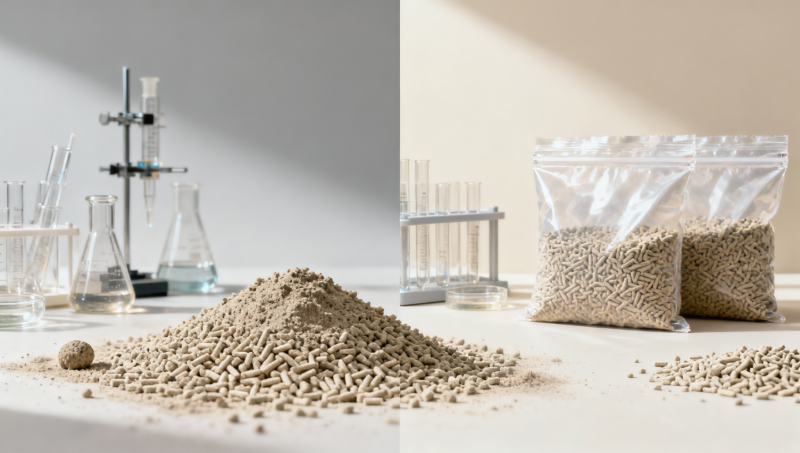
Many bentonite clay cat litter OEM projects fail testing not because of one dramatic defect, but because several small weaknesses stack together: variable raw ore quality, inconsistent granule sizing, poor moisture control, weak dust management, incomplete performance validation, and a mismatch between the promised specification and the actual target market standard. For buyers evaluating bentonite mineral cat litter wholesale or planning a natural mineral cat litter ODM program, the practical takeaway is simple: testing failure usually starts long before the final inspection. It begins at mine selection, formula control, process discipline, and verification planning.
For procurement teams, technical evaluators, quality managers, and brand owners, the real question is not only “Why did the sample fail?” but “How can we identify the hidden risks before mass production?” That is where a good OEM partner makes the difference. A factory with stable ore resources, long production experience, and clear quality control logic is far more likely to deliver consistent passing results than a supplier that only offers an attractive unit price.
What is the real search intent behind this topic?
Most readers searching this topic want to understand the root causes of testing failure in bentonite clay cat litter OEM projects before they commit to a supplier, approve a formula, or release a purchase order. They are usually trying to reduce three business risks at the same time:
- Product rejection during sample approval or import compliance review
- Inconsistent quality between development samples and bulk production
- Hidden cost increases caused by complaints, returns, reformulation, and delivery delays
That means the most useful content is not generic product theory. What readers really need is a practical framework: what fails, why it fails, how to check it early, and what kind of supplier control system lowers the risk.
Why do bentonite clay cat litter OEM projects fail testing so often?
In most cases, failure is not caused by one isolated issue. It happens because the OEM process is treated as simple packaging customization, when in reality it is a technical product development project. Bentonite cat litter must perform well across several indicators at once, including absorption, clumping strength, dust level, moisture content, odor control, bulk density, granule distribution, and transport stability.
When a supplier does not control these variables systematically, one problem often triggers another. For example, if the raw bentonite source changes, water absorption may shift. That can weaken clump formation, increase breakage during transport, raise dust, and finally lead to failure in customer-side testing. In other words, a failed test report is often only the visible result of upstream instability.
Unstable raw material quality is one of the biggest hidden risks
Bentonite is a natural mineral, and natural minerals are not automatically uniform. Even within the same region, ore quality can vary by layer, mining area, and extraction period. If a supplier relies on external sourcing without strict ore grading and blending control, the product may perform differently from batch to batch.
This is especially important in OEM and ODM projects because buyers often approve one sample and expect the same performance in every shipment. That expectation is reasonable, but it becomes difficult to meet when the supplier does not have stable mine access or disciplined raw material management.
Key failure symptoms linked to unstable raw material quality include:
- Clumping strength inconsistent from batch to batch
- Absorption speed slower than approved sample
- Color variation affecting retail presentation
- Unexpected dust increase after filling and transport
- Odor control performance that changes over time
A manufacturer with its own mine resources and long-term mineral handling experience is usually in a stronger position to control this risk because it can manage ore selection more directly instead of depending only on spot-market supply.
Formula control is often weaker than buyers expect
Many OEM buyers assume bentonite cat litter is only a raw mineral product and therefore does not require real formula discipline. In practice, even “simple” mineral cat litter depends on process and composition control. Particle size mix, drying level, sodium activation approach where applicable, dust reduction treatment, and deodorizing additions can all affect test outcomes.
If these elements are not standardized, the supplier may produce samples that look acceptable but fail under comparative or repeated testing. A project becomes even more vulnerable when the supplier adjusts the process informally to save cost after sample approval.
Common formula-control problems include:
- Too many fine particles, causing high dust and poor user experience
- Over-drying or under-drying, affecting clump formation and storage stability
- Insufficient strength in granules, causing breakage during handling
- Poor additive dispersion, leading to uneven deodorization performance
- Changes in granule ratio that alter absorbency and appearance
For technical evaluators and QC teams, this means one-time sample approval is not enough. They should ask whether the supplier has documented process parameters and batch consistency controls.
Testing standards are often unclear at the start of the project
Another major reason OEM projects fail testing is that the buyer and supplier are not aligned on what “pass” actually means. Different markets, brands, and channels may focus on different requirements. A distributor may care most about price and visible appearance, while an e-commerce brand may be highly sensitive to dust complaints, and an importer may focus on compliance documentation and packaging claims.
Without a defined testing framework at the beginning, suppliers may develop a sample according to their internal standards, while the buyer evaluates it according to another method entirely. That mismatch creates avoidable failure.
Before confirming an OEM cat litter project, both sides should clarify:
- Which physical performance indicators are mandatory
- What tolerance range is acceptable for each indicator
- Which lab or customer-side method will be used
- Whether transit simulation or storage simulation is required
- Which market regulations or retailer standards must be met
This step is especially important for multinational business because “acceptable quality” in one market may still fail retailer review or user expectations in another.
Dust, clumping, and moisture issues are the most common practical failure points
From a user and market perspective, three performance areas repeatedly decide whether a bentonite clay cat litter project succeeds or fails: dust control, clumping performance, and moisture balance.
Dust control: Excess dust is a common source of failed buyer evaluation and end-user complaints. It affects packaging cleanliness, shelf presentation, pet-owner satisfaction, and even warehouse handling conditions. Dust problems often come from poor screening, particle breakage, and inadequate process stability.
Clumping performance: Buyers usually expect fast absorption and strong, intact clumps that are easy to scoop. If the clump breaks apart, the product creates waste, odor retention issues, and a poor cleaning experience. Weak clumping can be caused by unstable ore properties, moisture imbalance, or excessive fines.
Moisture balance: Moisture that is too high may affect shelf stability and increase caking risk in storage. Moisture that is too low may reduce ideal clump behavior or make the litter more fragile during transport. Stable drying control is therefore essential, not optional.
These are not minor details. They are often the exact reasons why a sample passes initial viewing but fails actual use testing.
Bulk production fails when sample quality cannot be reproduced
One of the most expensive OEM mistakes is approving a development sample that cannot be replicated in mass production. This usually happens when the supplier prepares samples more carefully than regular production, uses a different raw material lot, or lacks process capability at volume.
For project managers and decision-makers, this is where supplier evaluation becomes more important than sample appearance alone. The right question is not just “Is this sample good?” It is “Can this factory reproduce this result consistently across multiple production runs and shipments?”
Warning signs include:
- Sample data without batch history
- No retained sample comparison system
- No in-process quality checkpoints
- Unclear production records for screening, drying, and packing
- Price pressure that encourages unannounced specification downgrades
A reliable OEM project requires process repeatability, not just a good first impression.
Packaging, logistics, and storage can also cause testing failure
Sometimes the litter itself is acceptable at the factory, but the delivered product still fails because packaging and logistics were not treated as part of quality control. Bentonite cat litter is heavy, granular, and sensitive to rough handling. Weak bags, poor sealing, high humidity exposure, or long transport vibration can change dust level, granule integrity, and final customer perception.
This matters for distributors, importers, and after-sales teams because many complaints emerge only after shipment, not during pre-shipment inspection. If testing is done on delivered goods rather than factory-fresh samples, logistics damage can become a hidden failure factor.
To reduce this risk, OEM projects should verify:
- Bag strength and sealing performance
- Palletization method and stacking pressure
- Container humidity considerations
- Resistance to granule breakage during transport
- Storage recommendations for distributors and end users
How buyers can evaluate an OEM supplier more effectively
If you want to avoid bentonite cat litter OEM testing failure, supplier evaluation must go beyond catalog review and price comparison. Buyers should assess whether the manufacturer can control the full chain from raw mineral source to finished product consistency.
A practical evaluation checklist includes:
- Does the supplier have stable access to bentonite resources?
- Can it explain the relationship between raw material grade and product performance?
- Are key quality indicators defined for every batch?
- Does the factory have documented screening, drying, and packing controls?
- Can it provide repeat test data rather than one sample result only?
- Is there OEM experience with different market requirements?
- Can the supplier support both product customization and quality verification?
For business evaluators and finance approvers, this approach also improves cost control. A slightly lower price from an unstable supplier often becomes more expensive after rework, delayed launch, and complaint handling are included.
How an experienced bentonite manufacturer reduces OEM project risk
An experienced manufacturer does not simply sell cat litter; it reduces uncertainty for the buyer. That means controlling ore quality, managing production parameters, understanding export expectations, and supporting OEM and ODM projects with realistic performance targets.
Weifang Hualong Bentonite Co., Ltd., founded in 1972 with its predecessor as a bentonite mine, benefits from long industry experience, complete national mineral approval qualifications, and an exclusive mine. Located in a bentonite-rich area of Shandong and within the one-hour economic circle of Qingdao Port and Weifang Port, the company is positioned to support international supply efficiency as well as raw material stability. Through OEM and ODM service capabilities and its export-focused sales company, Weifang Tianwu Import and Export Trading Co., Ltd., it aims to serve global customers seeking more dependable bentonite mineral cat litter supply.
For buyers, that kind of background matters because stable mineral sourcing and mature manufacturing control are closely linked to passing test requirements more consistently.
Final takeaway: prevent testing failure before the sample stage
If a bentonite clay cat litter OEM project fails testing, the problem usually started earlier than the test itself. In most cases, the root causes are unstable raw materials, weak process control, unclear approval criteria, poor bulk-production repeatability, or overlooked logistics effects. Buyers who focus only on final sample appearance often miss these deeper risks.
The better strategy is to evaluate the supplier’s mine stability, process discipline, testing alignment, and batch consistency before mass production begins. That is how procurement teams, quality managers, and brand owners reduce launch delays, protect product reputation, and avoid hidden total cost.
If you are comparing product options for OEM or wholesale programs, reviewing specifications such as particle structure and performance consistency can be a useful next step. One example is Crushed bentonite cat litter, which may be relevant for buyers assessing different bentonite litter formats and project requirements.
Leave A Message
CONTACT US