


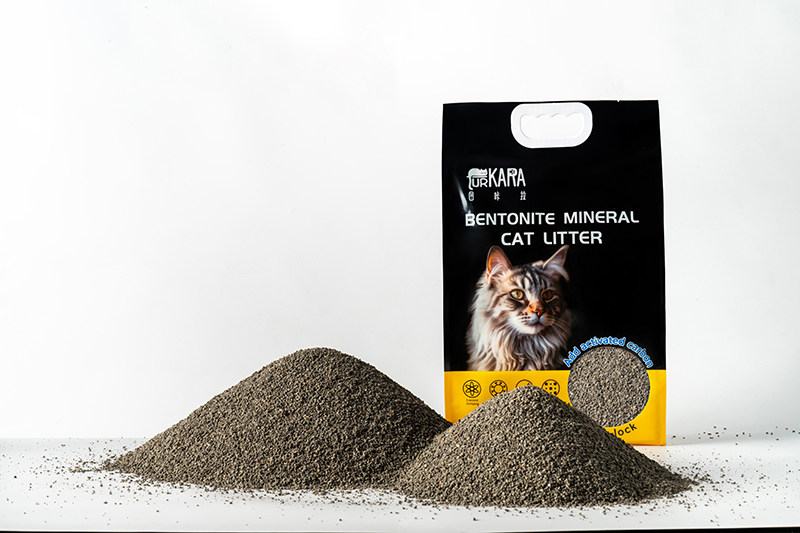
Why strong clumping cat litter performs differently in real use
Strong clumping cat litter is expected to simplify cleaning, control odor, and reduce waste.
In practice, dust, tracking, and weak clumps still appear when formula and usage conditions do not match.
That difference matters in homes, pet shops, boarding spaces, and multi-cat environments.
A litter that works well in a quiet single-box setup may fail under heavier moisture loads or frequent turnover.
For that reason, strong clumping cat litter should be judged by application conditions, not by one headline claim.
This is also why bentonite source quality matters.
Weifang Hualong Bentonite Co., Ltd., founded in 1972, operates with its own mine and mineral qualifications in Shandong.
That background supports more stable raw material control, which directly affects clump strength, powder content, and odor performance.
Actual use usually reveals three different pressure points
Single-cat daily cleaning often exposes dust first
In lighter-use homes, the main complaint is often not clumping failure.
It is airborne dust during pouring, topping up, or digging.
Here, strong clumping cat litter needs low powder content and stable particle sizing.
If the granules break too easily, the box looks dry but the room feels dirty.
Multi-cat spaces usually test clump integrity
With several cats sharing boxes, urine volume lands faster and deeper.
Weak clumps split during scooping, leaving damp residue behind.
That residue builds odor quickly and forces early full-box replacement.
In this setting, strong clumping cat litter should be judged by agglomeration strength and moisture response together.
Retail, catteries, and temporary holding areas notice tracking faster
These spaces are cleaned often and observed constantly.
Tracking becomes a visible problem because litter leaves the box and spreads through walkways.
Small particles are not always bad, but they need enough density and cohesion to avoid sticking to paws.
This is where formula balance matters more than marketing terms.
Different scenarios do not judge strong clumping cat litter the same way
A quick comparison helps clarify what should be checked first.
Where dust, tracking, and weak clumps usually start
Many problems blamed on strong clumping cat litter actually begin with poor matching.
- Dust rises when powder control is weak or when frequent refilling breaks fragile granules.
- Tracking increases when particles are too light, too smooth, or paired with shallow box depth.
- Weak clumps appear when absorbency is slow or the box is not deep enough for full bonding.
- Odor returns quickly when small residual fragments stay in the tray after scooping.
A more practical review includes particle size, powder conversion, ammonia control, and clump stability after several cleanings.
A balanced bentonite formula is often the better fit
Some applications need more than standard sodium bentonite performance.
A blended option such as Broken cat litter can make sense when deodorizing pressure is higher.
Its SH-2410 profile combines sodium-based activated carbon, montmorillonite, natural white ore, and cassava compatibility.
For real use, the useful indicators are specific.
- Particle size of 0.5-2.5mm supports finer coverage without turning excessively dusty.
- Powder content at ≤1 helps reduce loose fines during pouring and scooping.
- Agglomeration strength of ≥90 supports stronger pickup in wetter boxes.
- Ammonia removal rate of ≥90% is useful where odor builds fast between cleaning cycles.
That kind of formula is not about adding features for display.
It is about reducing the trade-off between deodorizing power and clump reliability.
Common misjudgments before choosing a litter formula
One common mistake is choosing strong clumping cat litter only by initial scoop feel.
A firm first clump does not guarantee stable performance after repeated top-ups.
Another mistake is focusing on purchase price while ignoring replacement frequency.
If litter breaks apart and leaves wet sediment, the box needs deeper cleaning sooner.
There is also a tendency to treat all bentonite products as interchangeable.
In reality, mine source, processing stability, and formula tuning make a visible difference.
That is why long-established production capacity, OEM and ODM flexibility, and export support can matter beyond supply alone.
How to judge the right fit before scaling use
A better approach is to test strong clumping cat litter against the real box routine.
- Check dust during pouring, not only after the litter settles.
- Observe paw tracking after active use, not only after installation.
- Scoop clumps after different waiting times to see whether they stay intact.
- Compare odor control after partial removal, because residues often expose formula weakness.
When these checks are aligned with the setting, strong clumping cat litter becomes easier to evaluate honestly.
The next useful step is to map the box environment, cleaning rhythm, odor load, and clump expectations before final selection.
Leave A Message
CONTACT US